Shivesh Prakash
Machine learning for markets
I’m a Master of Financial Engineering student at UC Berkeley’s Haas School of Business, graduating in March 2027. I research and build trading and forecasting models: pricing prediction markets against options, combining forecasts online when feedback arrives late, reading financial news with language models, and making markets.
In summer 2026 I was a Quantitative Research Summer Associate at JPMorganChase in New York, and this fall I’m on MFE industry projects with Millennium Global and Citi. Before Berkeley I studied computer science and statistics at the University of Toronto. I also trade competitively: first among all MFE students in Berkeley’s high-frequency trading competition, and world top 10 in Akuna Capital’s Quant Trading Challenge.
I’m looking for full-time roles in quantitative research and trading, and in machine learning and data science, starting March 2027. I’m happy to relocate to any major financial center.
Research
-
Priced as If Too Volatile: The Favorite–Longshot Bias in Prediction Markets and Its Collapse
Working paper, 2026.
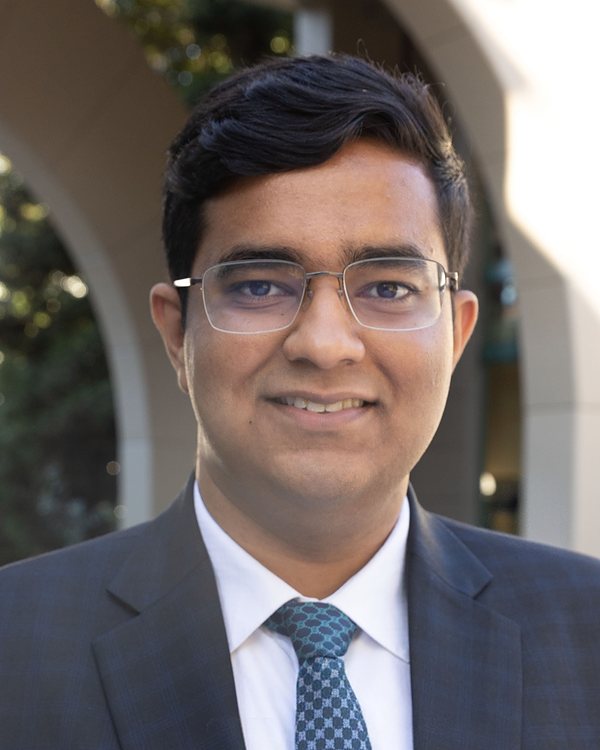
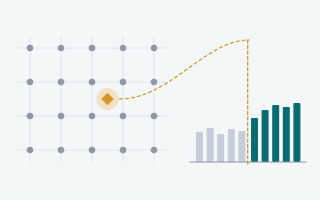
Many prediction-market contracts pay what portfolios of options pay, so Deribit’s options can price them. Until mid-2025 Polymarket priced Bitcoin and Ether longshots about a quarter above the options, as if volatility were 11% higher, and Kalshi charged buyers a wide spread. Then Polymarket’s premium fell by about 90% within weeks. A pricing convention among dealers fits both the premium and its collapse, and selling it against a tight option hedge still lost money. The data cover 9,396 contracts and 7.03 million taker fills.
-
Stay CALM: Calibrated Online Aggregation for Multi-Horizon Forecasting under Delayed, Overlapping Feedback
Preprint, 2026.
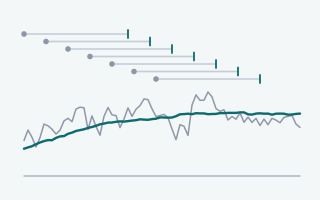
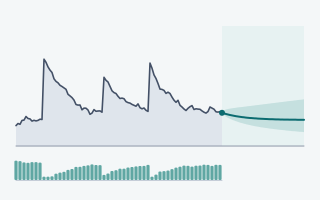
A forecast for h steps ahead is scored only h steps later, and neighboring forecasts share targets, so online combiners tuned for independent feedback chase noise. CALM divides each learning rate by an overlap factor, with no tuning. It beat the leak-free state of the art in 88 of 90 pre-registered runs, with 6.2% lower error on average at about 1 ms per update, and cut the error of 30-minute volume forecasts on CME futures by 12.7% versus the base model.
-
Reading the News Without Hindsight: NoLBERT Topics and the Cross-Section of Stock Returns
SSRN, 2026. Follows From Word Counts to Context: Topic Models for Asset Pricing (arXiv, 2026).
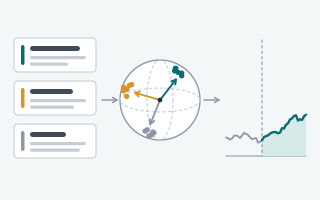
Topic models of 1.26M news articles, built so that no text from the future leaks in. Contrastive fine-tuning of NoLBERT, a no-look-ahead language model, lifts top-1 matching on unseen 2022–24 news from 3% to 86%, and a price + news ensemble earns an out-of-sample net Sharpe ratio of 1.12 after costs. The first paper compares LDA with sentence-transformer topics on 394K articles.
-
FOMO: FLEX Options and Market Outcomes
arXiv, 2026. UC Berkeley MFE industry project with NewMark Risk.
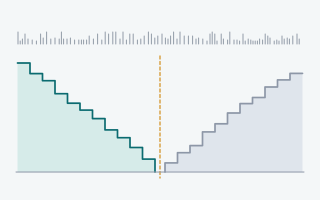
FLEX options let institutions set their own strikes and expiries. Across 41 underlyings and 53 event dates, FLEX activity selects into high-implied-volatility environments and signals volatility demand, not stock direction. Matched difference-in-differences shows listed-option open interest rising by 0.306 log points (about 36%) after FLEX events, and event-day gaps between implied and realized volatility predict cost-stressed short-straddle returns.
-
NanoTick: a limit-order-book replay engine
Independent project. C++20, with Parquet, PyArrow and Numba tooling.
Normalizes raw Nasdaq TotalView-ITCH data into Parquet and replays the displayed L3 order book in C++20: 30M BX messages at 4.8M messages per second on an M1 Mac, with an average p99 of 284 ns per book operation and no order-state errors across a full trading day.
-
A User-Tunable Machine Learning Framework for Step-Wise Synthesis Planning
Digital Discovery, 2026.
MHNpath plans chemical syntheses one step at a time, ranking reaction templates with modern Hopfield networks. Chemists can weight routes by cost, temperature and toxicity, and it solves 85.4% of PaRoutes targets.
-
In progress
Zero-shot FX forecasting with time-series foundation models
Millennium Global (MillTech). UC Berkeley MFE industry project, Oct–Dec 2026.
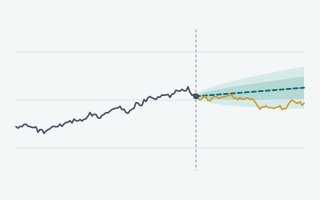
Testing whether zero-shot forecasts from Chronos-2, a transformer, and TiRex-2, an xLSTM, improve time-series and cross-sectional momentum in the G10 currencies at 5- and 20-day horizons. Forecast distributions become vol-scaled positions in a cost-aware backtest on forward (spot plus carry) returns, against momentum and 50/50 hybrid signals.
-
In progress
Proving a BTP–Bund futures hedge correct in Lean 4
Citi. UC Berkeley MFE industry project, Oct–Dec 2026.
A machine-checked proof that a BTP–Bund futures hedge meets its written specification, extended to semi-Markov regime switches, jumps and options. Language models draft the proof steps and Lean checks every one.
-
VIXtrader: VIX Forecasting and Futures Trading
Working paper, 2025.
An LSTM on macro and ARMA features forecasts the 34-day VIX, cutting MAE by 10% and doubling R² against the baseline. Dynamic-leverage strategies built on the forecast reach backtested Sharpe ratios 2.6 times those of passive benchmarks.
-
SEE-2-SOUND: Zero-Shot Spatial Environment-to-Spatial Sound
SIGGRAPH 2025 Posters; ICML 2024 workshop.
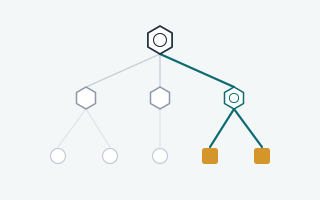
Generates 5.1 surround sound for images and videos with no training: find the regions that make sound, place them in 3D, generate audio for each, and mix them into a spatial track.

More research
- Organization Design with AI Agents. In progress, with Ali Kakhbod: how teams of LLM agents running a quant book should be organized and paid. The pilot uses schema-constrained JSON agents, cached replayable calls and leave-one-out attribution for each analyst.
- Equivariant Graph Neural Network for Rapid Transition State Structure Predictions in Chemistry. A LeftNet-based model predicts transition-state geometries from reactants and products with 18.6 pm mean absolute error; Best Poster at the UofT Data Sciences Institute. Working paper, 2025. Paper
- Efficient Training of Transformers for Molecule Property Prediction on Small-scale Datasets. Blood–brain-barrier permeability from a small dataset, at 78.8% ROC-AUC on BBBP. arXiv, 2024. arXiv
- Beyond the Visible. Diffusion-based denoising of hyperspectral images for the FINCH CubeSat, with the University of Toronto Aerospace Team. arXiv, 2024. arXiv
- Material sensing. Sub-second hyperspectral capture and a DNG-to-RGB demosaicing pipeline, with trained material classifiers. Code
- DygnosTech. GAN-based prediction of drug side effects with WebAssembly-optimized models; won MetroHacks. Code
Experience
-
Oct–Dec 2026London, remote
Millennium Global MillTech
Quant Researcher, UC Berkeley MFE industry project
Testing zero-shot time-series foundation models (Chronos-2, TiRex-2) against classic momentum in G10 FX, in a cost-aware backtest on forward returns.
-
Jun–Aug 2026New York
JPMorganChase
Quantitative Research Summer Associate, Quant Trading & Research
- Cut T+1 forecast error (MAE) by 15% against a seasonal baseline, using a 50K-per-day transaction stream and microstructure features.
- Built a real-time forecasting engine with settlement prediction, clustering and path inference from flows.
- Mapped unstructured news into directional NLP factors to explain event-driven regime switches in capital flows.
-
Sep 2025 – Feb 2026Mumbai
EY
Intern, Treasury Quant Team
Built a privacy-first retrieval-augmented query engine for corporate treasury that helped win four new clients.
-
Jun–Sep 2025Delhi
Pace Stock Broking Services
Quantitative Research Intern, HFT Desk
Clustered co-moving stocks from minute-level returns (PCA/LSTM + HDBSCAN); cluster returns showed 3.3% autocorrelation.
-
Jun 2024 – Aug 2025Toronto
University of Toronto
Research Assistant
Competitions and honors
| Trading competition | Result | What I did |
|---|---|---|
| Berkeley MFE HFT Competition | 1st place Among all MFE students | Ran a market maker blending nine short-horizon forecasts, each weighted by its live accuracy. |
| Akuna Capital Quant Trading Challenge | World top 10 | Built an options market maker with binomial pricing and delta hedging. |
| Moreton Capital | #2 | Made a 35% return trading real money on Polymarket; selected to manage $10K in its prediction-market fund. |
| IMC Prosperity 4 | #62 of 19K teams Algorithmic trading; #32 in the US | Built a backtesting engine, then traded pairs and ETF statistical arbitrage. |
| Stevens High Frequency Trading Competition 2026 | #23 | Used order-book imbalance to trade tick-level DJIA books against other teams, zero-intelligence bots and RL agents. |
- JEE All India Rank 389, top 0.04% of candidates
- Physics Olympiad, first in state and national top 1%
- Regional Math Olympiad qualifier, twice
- International Scholar, University of Toronto ($100K)
- Best Poster, UofT Data Sciences Institute SUDS
- Passed Level I of the CFA Program
Education
-
Expected Mar 2027
University of California, Berkeley
Master of Financial Engineering, Haas School of Business. GPA 3.8/4.0.
Stochastic Calculus with Asset Pricing, Derivatives, Fixed Income, High-Frequency Finance.
-
May 2025
University of Toronto
Honours BSc in Computer Science, minor in Statistics. GPA 3.88/4.0.
Machine Learning (A+), Math of Finance (A+), Graduate Optimization (A), Probabilistic Learning (A). DSI Award; three-time Dean’s List.