Listed open interest rises
Matched-control difference-in-differences finds a robust post-event increase in log listed-option open interest.
p = 0.0042 · BH-adjusted p = 0.0168FLEX Options and Market Outcomes
FLEX options let institutions customize contract terms while keeping exchange trading and central clearing. We study the public traces those bespoke contracts leave in listed options and equities.
*Haas School of Business, UC Berkeley · NewMark Risk
Research question Does customized institutional option activity spill into regular listed-option positioning, volatility, or stock returns?
The instrument
Standard options trade at exchange-defined strikes and expirations. FLEX options preserve exchange trading and central clearing while letting counterparties choose nonstandard strikes, dates, exercise styles, and settlement terms.
That makes FLEX a useful revealed-preference signal. A customized contract says that some participant wanted exposure the standard chain did not naturally provide, even when their precise motive remains unobserved.
Exchange grid
Custom
Listed cycle
Custom date
Contract-defined
Customizable
Central
Central
Interactive explainer
A FLEX position is not split across nearby strikes or expirations. It can be consolidated only when an ordinary listed series appears with the same contract terms.
The key distinction: consolidation transfers the existing open interest into one identical non-FLEX series. It is not replication, interpolation, or a basket of nearby contracts. If an exact look-alike is never listed, the position remains FLEX. See the Options Industry Council explainer and Cboe conversion notice.
Empirical design
We link customized FLEX events to regular option markets and equities, then compare each event with a non-FLEX control selected on comparable pre-event conditions.
Identify an underlying and effective date from a reportable FLEX consolidation.
Match on price, spread, implied volatility, option volume, and open interest.
Measure listed-option liquidity, positioning, volatility, and adjusted equity returns around the event.
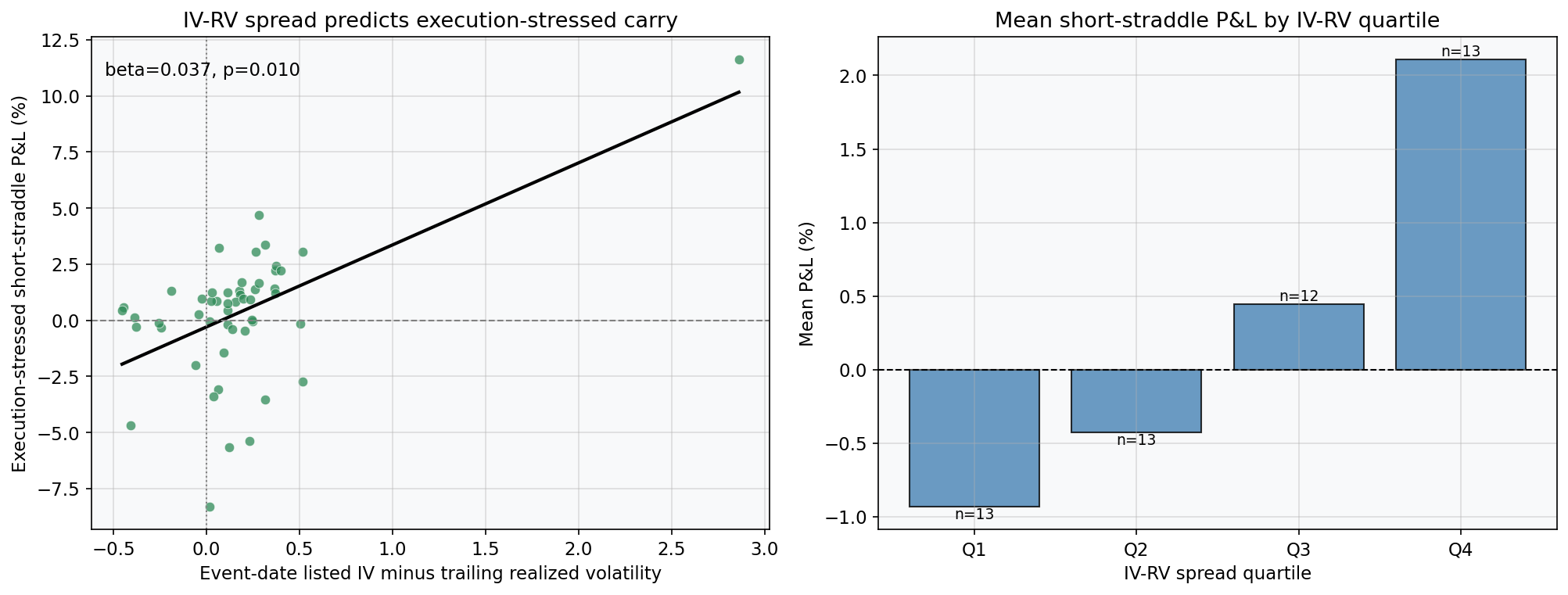
Apply transaction-cost and latency assumptions to volatility-carry strategy prototypes.
Main findings
FLEX activity is most useful as a marker of institutional volatility demand and outstanding option positions, not as a durable stock-return signal.
Matched-control difference-in-differences finds a robust post-event increase in log listed-option open interest.
p = 0.0042 · BH-adjusted p = 0.0168The date-fixed-effect ATM IV premium is concentrated in mid-price underlyings and survives outlier checks.
β = 0.1235 · p = 0.0030A same-day adjusted return difference appears, but it does not persist over one-to-five-day horizons.
CAR₀ p = 0.0442 · later horizons not significantEvidence map
Listed open interest is the clearest post-event footprint, consistent with regular options being used to hedge, warehouse, or complement customized exposure.
Full research record
The paper presents the empirical design, robustness tests, execution assumptions, and limitations. The technical report preserves the full notebook-style analysis and diagnostics without releasing the underlying research code or data.
Interpretation
Selection is part of the signal. Elevated IV appears before some events, so FLEX exposure is not interpreted as a clean causal shock to volatility.
Directionality is weak. The data do not support presenting FLEX activity as a persistent equity-return predictor.
Execution matters. Bid-ask spreads, fees, latency, sample size, and aggregate rather than leg-level data constrain trading claims.
Citation
@article{prakash2026fomo,
  title  = {FOMO: FLEX Options and Market Outcomes},
  author = {Prakash, Shivesh and Ferstler, Frank and Pezolano, Nicholas},
  year   = {2026},
  note   = {Working paper}
}